
store-core
The platform layer that runs once: gateway, uaa, console, tenancy, billing, pod-registry.
store-core is the control plane. It knows who the users are, which organizations own which stores, what each store is entitled to, and which pod hosts it. It holds none of a store's own data; that lives in the pod (store-pod). Six containers share one Postgres, each in its own schema, in the namespace store-core.cvhome.lcl behind store-core-gateway. Shapes follow the legend.
Diagram C2a
The request path for a signed-in merchant: browser → store-core-gateway → console-ui for the shell, then /tenancy/**, /billing/**, /pod-registry/**, /uaa/** on the same origin for data, and /spg/**?store=<id>&pod=<podId> for anything that lives in the store's pod. The gateway runs the OAuth2 authorization-code flow against uaa, keeps the session, and relays the access token on every backend route. console-ui never holds a token. Details: Authentication, Gateway routing.
store-core-gateway (:8000)
Reactive Spring Cloud Gateway (spring-cloud-starter-gateway-server-webflux). Main class StoreCoreGatewayApplication.
Owns. The browser session and the OAuth2 client login against uaa (SecurityConfig, CapturingServerOAuth2AuthorizationRequestResolver, RedirectingServerAuthenticationSuccessHandler, AuthController, LogoutController); the static route table (GatewayRouteLocatorImpl); the per-pod route table (PodClient).
Routes (GatewayRouteLocatorImpl):
| Path | Target | Filters |
|---|---|---|
/tenancy/** | lb://tenancy | stripPrefix(1), tokenRelay(), preserveHostHeader() |
/billing/** | lb://billing | same |
/pod-registry/** | lb://pod-registry | same |
/uaa/** | lb://uaa | tokenRelay(), preserveHostHeader(), X-Forwarded-Prefix: /uaa; the prefix is kept because uaa builds absolute URLs from it |
/spg/** with store= and pod=<id> | that pod's spg | StripPrefix=1, TokenRelay; one route per pod, built by PodClient |
everything else on gateway.com, www.gateway.com, console-ui.gateway.com | lb://console-ui | preserveHostHeader() |
The backendServices array (tenancy, billing, pod-registry, uaa, spg) is negated to build the console's catch-all; a backend missing from it is answered with the console's HTML.
PodClient. Implements RouteDefinitionRepository. On a schedule (cvhome.gateway.route-refresh-rate, default PT1M) it calls pod-registry's ReactiveExternalPodService.listPods() and rebuilds one route per pod, id pod-<short id>, URI from ServiceUrlBuilder (lb://spg.<namespace> for an INTERNAL endpoint, the URL itself for EXTERNAL). The table is seeded from configuration at start, a failed refresh keeps the last-known-good set, and a RefreshRoutesEvent is published only when the set changed. PodRoutesHealthIndicator reports how long ago the last refresh succeeded.
Database. None.
uaa (:8001)
Spring Boot service embedding the Angular 20 admin app uaa-fe (src/main/resources/uaa-fe, built on @cvhome-saas/ui-kit, copied into static/ before processResources). Main class UaaApplication. Built on store-commons/sso/sso-core, the same authorization-server core as the pod's cua.
Owns. Staff and merchant identity for the whole platform: the OAuth2 authorization server and OIDC provider every other service trusts; users, roles, clients, settings, signing keys (rotated on a schedule, private halves encrypted with secret-crypto), sessions, audit, invitations; brokered login through external OIDC and OAuth 2.0 providers (idp/, security/Brokered*). There is no self-registration: accounts are provisioned or invited and their owner sets a password through a one-time link.
External API. /api/v1/admin/** (users, roles, clients, settings, keys, identity providers, audit, sessions, dashboard), gated on SCOPE_super_admin or ROLE_SUPER_ADMIN in AppSecurityConfig and again by @PreAuthorize per method. Reached from the console through the gateway's /uaa/** route, and directly on uaa.gateway.com, where the admin app is served. Services manage users through the uaa-client SDK. A client_credentials client per service (scope store_core or store_pod) is how services authenticate to each other.
Database. Its own schema in the store-core Postgres: JDBC sessions and a JDBC authorization store, so refresh tokens survive a restart and can be revoked.
console-ui (:8011)
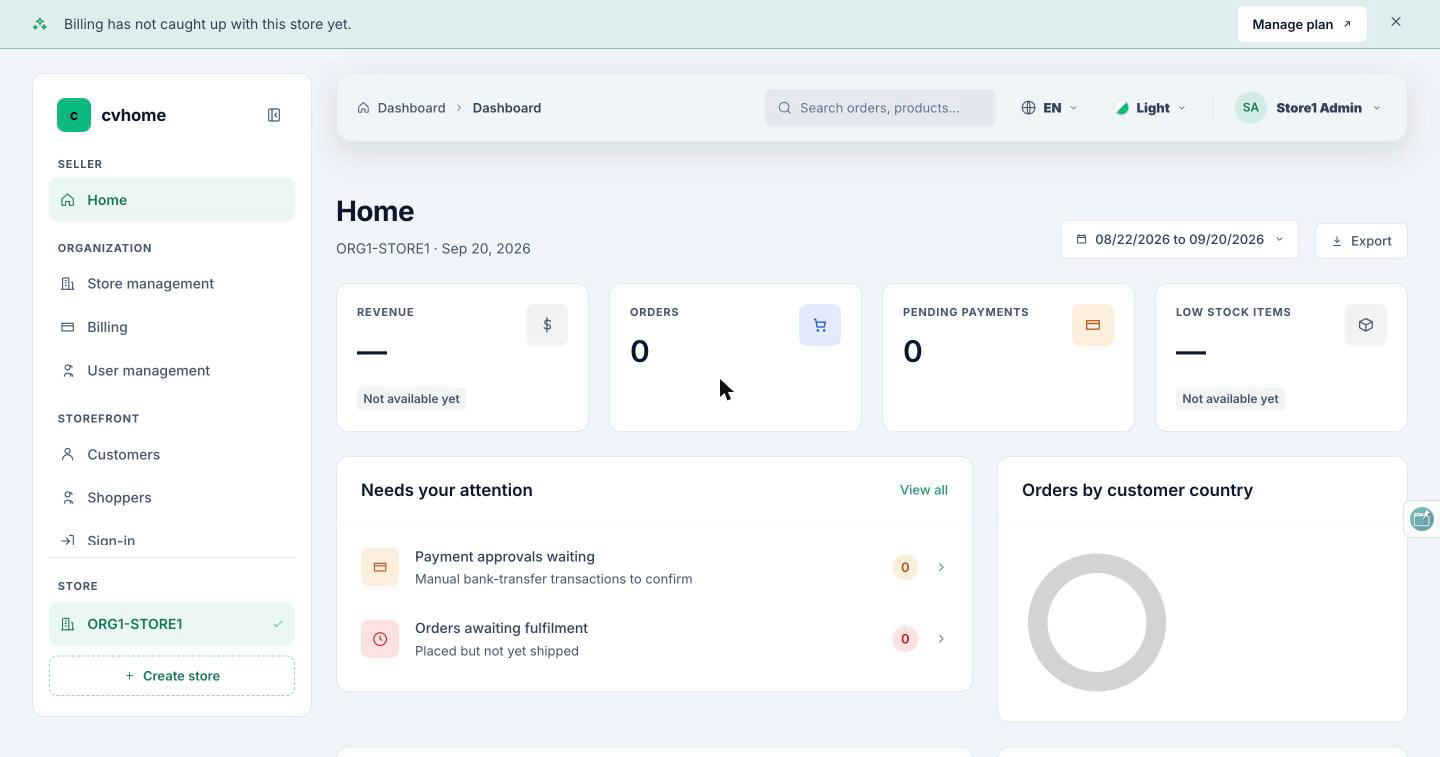
Angular 20, standalone components, server-side rendering (app.config.server.ts, app.routes.server.ts), Tailwind v4 over a three-theme token layer, Transloco (en, ar, RTL), @cvhome-saas/ui-kit. Signs in by redirecting to /oauth2/authorization/uaa on the gateway.
Owns. The merchant console and the platform-admin console, one app. Thirty-one feature areas under src/app/features/:
| Group | Feature areas |
|---|---|
| Merchant | dashboard, orders, order-details, catalogue, products, product-form, content, storefront-builder, marketing, customers, shoppers, payments, store-management, create-store, users, identity-providers, billing, subscription, profile, legal |
| Platform admin | organizations, organization-detail, pods, pod-detail, platform-plans, platform-billing, platform-users, platform-dashboard |
| Shell | auth, first-run, not-found |
Layers are tiered features → layouts → shared → api → core → models; the module's ARCHITECTURE.md is the contract.
Database. None.
tenancy (:8020)
Spring Boot, tenancy-service, with the libraries tenancy-commons (DTOs, ProvisioningState) and tenancy-events (OrgCreatedEvent, StoreCreatedEvent, StoreProvisionedEvent, published through the namastack transactional outbox).
Owns. Organizations (ManagerOrgId), stores (StoreMerchantId), members and sign-up, and the store → pod routing table. ManagerStoreEntity.podId (tenancy.manager_store.pod_id) records which physical pod hosts each store; every downstream decision, from which gateway route matches to which region holds the data, derives from that column.
Provisioning. Creating a store writes the row with NOT_STARTED_PROVISIONING and StoreCreatedEvent into the outbox in the same transaction. The outbox delivers it to StoreProvisioningService, which marks IN_PROGRESS, asks pod-registry for placement (PodPlacementApi), builds a MerchantStorePodClient aimed at that pod (StorePodClientFactory) and creates the store in the pod's own merchant service, then marks SUCCESSFULLY_PROVISIONING or FAILED_PROVISIONING (the outbox retries). See Tenancy and provisioning.
External API. StoreManagerController, OrgManagerController, SignUpController, UserAccountController, SaasController, RouterController (resolves a store to its pod for internal callers), StoreStatisticApi, OrgStatisticApi; reached as /tenancy/**.
Database. Schemas tenancy (manager_org, manager_store) and tenancy_outbox; Spring Data JDBC, DDL in schema.sql.
billing (:8021)
Spring Boot, billing-service, with billing-commons (ids, enums, DTOs, error catalog), billing-events (subscription events and commands) and billing-external-api (entitlement and quota clients).
Owns. Plans (PlanCatalogService), per-store subscriptions (SubscriptionService, SubscriptionAuditService), Stripe integration (WebhookIngestService, WebhookApplyService), entitlements (EntitlementService) and store quotas (StoreQuotaService).
External API.
| Path | Purpose | Caller |
|---|---|---|
PlanCatalogApi, SubscriptionApi | Plans and a store's subscription | console via /billing/** |
POST /api/v1/stripe-webhook/public/events | Stripe's events | Stripe |
GET /api/v1/entitlement/private/snapshot, POST .../snapshot/batch, GET .../blocked-stores | What a store is entitled to | catalog (product writes through StoreEntitlements), the gateway, tenancy |
POST /api/v1/quota/private/store-create, POST .../provision | Store quotas at creation and provisioning | tenancy |
The entitlement snapshot is the one call a pod makes back into store-core.
Database. Its own schema in the store-core Postgres.
pod-registry (:8022)
Spring Boot, pod-registry-service, with pod-registry-commons (PodView, placement DTOs, lifecycle and health enums) and pod-registry-external-api (ExternalPodService, ReactiveExternalPodService, the placement client). Split out of tenancy in 2026-08; tenancy keeps the store → pod binding, pod-registry owns the pod.
Owns. The pod catalog: identity, endpoint, private-organization assignment, lifecycle, health, capacity and placement decisions. A pod's PodEndpoint is INTERNAL (same cluster, reached as lb://spg.<namespace> through service discovery) or EXTERNAL (a URL anywhere: another region, account or cloud). A pod with an orgId is dedicated to that organization; without one it is in the shared pool.
External API. PodApi at /api/v1/pod: GET list (the gateway's PodClient, with SCOPE_STORE_CORE), GET, GET {id}, POST, PUT {id}, POST {id}/drain; creating, updating and draining a pod is ROLE_SUPER_ADMIN only, listing is scoped to the caller's organization unless super admin. PodPlacementApi answers tenancy's placement request.
Database. Schema pod_registry (pod_registry.pod).
Source of truth: cvhome .claude/skills/project-structure/references/store-core.md, references/multi-tenancy.md, references/authentication.md, references/database-schemas.md, store-commons/autoconfigure/src/main/resources/common-config.yml, store-core/gateway/gateway-service/src/main/java/com/asrevo/cvhome/gateway/config/GatewayRouteLocatorImpl.java, store-core/gateway/gateway-service/src/main/java/com/asrevo/cvhome/gateway/client/PodClient.java, store-core/console-ui/src/app/features/, store-core/billing/billing-service/src/main/java/com/asrevo/cvhome/billing/api/v1/, store-core/pod-registry/pod-registry-service/src/main/java/com/asrevo/cvhome/podregistry/api/v1/PodApi.java.