AWS Deployment Architecture
This document provides a simplified overview of the AWS architecture used for deploying the cvhome multi-tenant platform.
Overview
The architecture uses managed AWS services to create a scalable, highly available, and secure environment for running the application's containerized microservices and frontends via AWS Fargate.
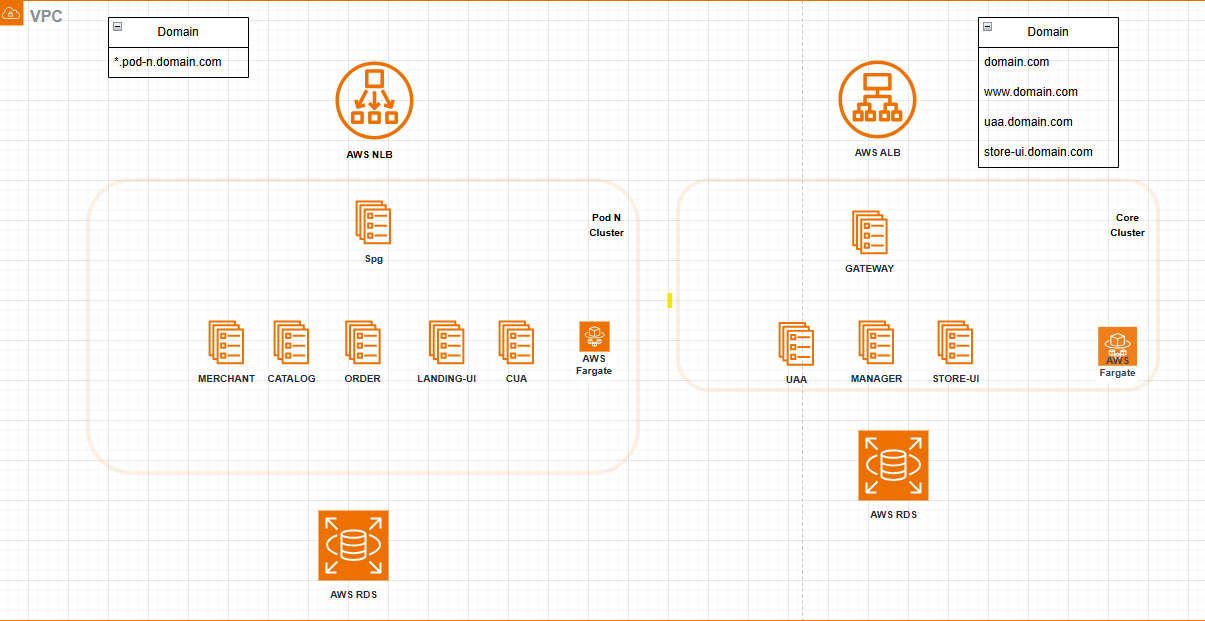
Main Components & Purpose
Compute (AWS Fargate + Amazon ECS):
- Runs the application containers (API Gateway, backend services, frontends) without needing to manage servers.
- Orchestrates the deployment and scaling of these containers.
Networking (Amazon VPC, Application Load Balancer, AWS Route 53, AWS CloudMap):
- Provides an isolated network environment (VPC).
- Distributes incoming web traffic to the correct containers, handles SSL/TLS (ALB).
- Manages DNS records, routing traffic for the main platform domain and tenant-specific domains/subdomains to the ALB (Route 53).
- Internal service to service communication using CloudMap
Data Storage (Amazon RDS + Amazon S3):
- Provides a managed PostgresSQL database for application data (tenants, products, orders, etc.) (RDS).
- Stores static files like images, assets, and tenant customizations (S3).
Key Benefits of this Architecture
- Scalability: Services can scale automatically based on demand.
- High Availability: Uses multiple Availability Zones to minimize downtime.
- Security: Leverages AWS security features for network isolation, access control, and secrets management.
- Reduced Operational Overhead: Relies on managed services, reducing the need for server patching and maintenance.
- Multi-Tenancy Ready: Designed to handle custom domains/subdomains for different tenants via Route 53 and NLB.
This is a high-level view. For specific configuration details, refer to the deployment guide and the infrastructure code.